If you built your Facebook group marketing on Buffer, Hootsuite, or a custom Graph API integration, April 2024 was the month it stopped working for joined groups. Meta removed third-party access to post into groups you belong to. Not deprecated slowly. Removed.
In this post we explain what changed, why Meta did it, and what group marketers use today instead.
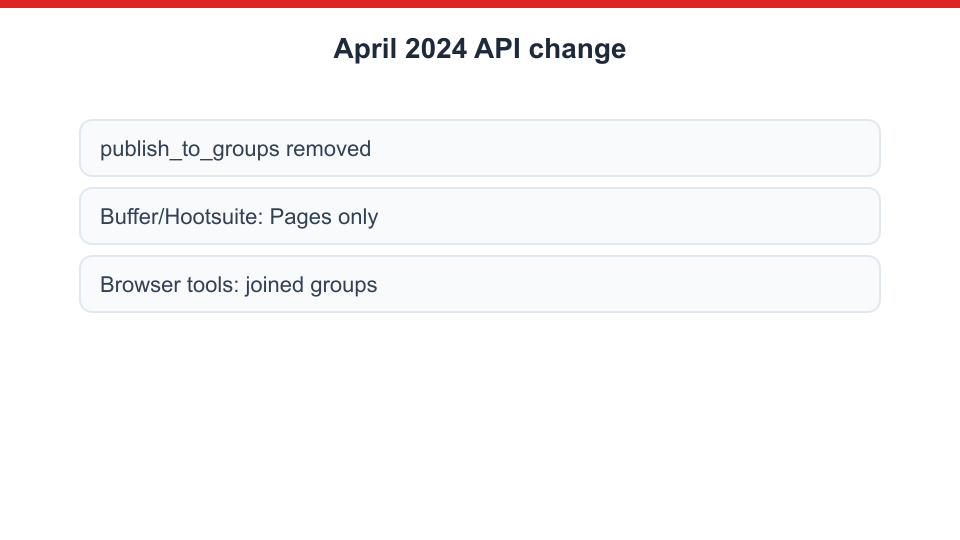
The Graph API permission publish_to_groups let approved apps post to Facebook groups on behalf of logged-in users. Marketing tools used it to schedule promotional content, cross-post announcements, and run agency workflows from cloud dashboards.
In April 2024, Meta cut off new approvals and began revoking access for existing apps. By late 2024, mainstream schedulers could no longer publish to joined groups through official API tokens.
What still works via API:
- Facebook Pages (with correct permissions)
- Instagram, LinkedIn, Twitter/X on multi-platform tools
- Ads and Business Manager integrations
What no longer works via API for typical marketers:
- Posting to groups you joined as a member
- Bulk group campaigns from cloud servers
- “Connect Facebook and auto-post to 100 groups” SaaS built on Graph tokens
Read the Graph API glossary entry for permission vocabulary.
Meta’s public reasoning centers on spam reduction and user safety. Open group posting APIs enabled:
- Affiliate blast tools posting identical offers across thousands of groups
- Low-quality apps with weak review standards
- User confusion about which app posted on their behalf
Group admins complained about promotional floods. Meta tightened the funnel. Pages stayed open for business use. Member group posting went back to human-session behavior only.
Whether you agree with the policy or not, the API is not coming back for typical marketing use cases. Waiting for Meta to reopen publish_to_groups is not a strategy.
What broke for operators
Multi-platform schedulers lost a major use case overnight. Buffer, Hootsuite, Later, and Sprout Social users who relied on group scheduling had to revert to manual posting or find alternatives. See MaherPost vs Buffer and MaherPost vs Hootsuite.
Custom agency tools built on Graph tokens needed rewrites. Some shut down. Others pivoted to browser automation.
Chrome extension posters became the functional category for group bulk posting. Tools like MaherPost, PilotPoster, and Group Posting PRO post through the user’s logged-in browser session using Facebook’s internal web endpoints, not the public Graph API.
Compare approaches in chrome extension vs Graph API tools.
Browser-session posting: the replacement architecture
Browser-session posting means:
- User logs into Facebook in Chrome
- Extension attaches to the active session
- Posts publish through the same path as manual clicks
- Delays and variation mimic human pacing
Tradeoffs:
Pros: Still works in 2026. Reaches joined groups. No dead API token.
Cons: Your personal account carries risk. You must respect posting limits and account health. Campaigns run while your browser is available, not on a headless cloud cron.
MaherPost is built entirely on this model. We do not pretend cloud API group posting exists.
What about unofficial APIs and scrapers?
Some tools use reverse-engineered endpoints or mobile API emulation. These break when Facebook changes internals. They often violate Terms of Service. Accounts using them face higher restriction rates.
We recommend extensions that operate in visible browser sessions with explicit user action, not headless bot farms.
Migrating from a dead API workflow
If you are coming from Buffer-style scheduling:
- Export your group list from wherever you tracked it (spreadsheet, CRM, old tool)
- Audit group rules again. Two years of promo policies may have changed
- Rewrite copy with spintax for variation. API-era identical cross-posts will not fly. Use the spintax generator
- Start with warmup pacing on a browser tool. Read account warmup for bulk posting
- Run a small test campaign (5-10 groups) before rebuilding full volume
See migrate from abandoned poster tools for tool-specific notes.
Buffer and Hootsuite remain excellent for:
- Instagram carousels and Reels scheduling
- LinkedIn thought leadership
- Facebook Page content calendars
- Team approval workflows on brand Pages
Use cloud schedulers for Pages. Use MaherPost for joined groups. Most serious operators run both.
The 2026 stack for group marketers
| Layer | Tool type | Example |
|---|
| Group bulk posting | Browser extension | MaherPost |
| Page + IG scheduling | Cloud scheduler | Buffer, Later |
| Intent monitoring | Browser feed scanner | Lead Radar |
| Content variation | Spintax + AI | MaherPost |
| Risk monitoring | Account Health score | MaherPost |
Honest risk language
Browser tools are not “ban proof.” Meta still detects spam patterns. The difference is you control variation, delays, and volume with tools designed for group operators.
Read is Facebook auto poster safe before scaling.
Next steps
- Accept that Graph API group posting is dead
- Pick a browser-session tool aligned with your volume
- Rebuild campaigns with variation and conservative pacing
- Monitor delivery logs weekly
Get MaherPost →